[Series] FESCARO's Automotive Cybersecurity FAQs
FESCARO has been operating the ‘FAQs Series’ to address cybersecurity issues for stakeholders in the automotive industry. We have conducted live webinars on four key topics, and the expert panel from FESCARO provided answers to the most commonly asked questions from industry professionals. If you missed a webinar on a topic that interests you, you can access both the recorded video and a text summary (FAQs) at the following link.
# FAQs Series
1. Cybersecurity Strategies for Tiers (Emerging-OEMs oriented)
2. Comprehensive Guide on Cybersecurity Solutions & Engineering
3. Cybersecurity Testing method based on VTA Success Stories
4. ECU Cybersecurity guidance : From production to post-mass production
5. How Korea’s Motor Vehicle Management Act Amendment impacts OEMs and Tiers
The webinar, titled <How Korea’s Motor Vehicle Management Act
Amendment impacts OEMs and Tiers>, held by FESCARO on Wednesday, April 3,
concluded with great interest. The fact that more than
160 people pre-registered for the webinar underscores the significance of the ‘Korea’s
Amendment to the Motor Vehicle Management Act’ within the industry.
Addressing inquiries about the Motor Vehicle Management Act, FESCARO prioritized
the questions industry practitioners are most curious about. Are you interested in response strategies and
practical know-how for complying with the Motor Vehicle Management Act? Please check the expert panel's clear
answers in the video and text!
■ Expert Panels
ㆍDirector Ku Seong-seo (an iconic
figure of the FESCARO’s webinar): 20+ years of experience in embedded system SW
development, including automotive controllers and security solutions
ㆍTeam leader Choi
Kwang-mook (key player of the FESCARO’s grand slam): 20+ years of experience in
automotive certification consulting, including CSMS, SUMS, ISO/SAE 21434, etc.
■ QUESTION LIST
1. Description of Korea’s amendment to the Motor Vehicle
Management Act
2. How is it different from UN certifications (R155 ·
R156)?
3. Is it replaceable by UN certifications (R155 · R156)?
4. Cybersecurity and software update-related contents in
the Motor Vehicle Management Act
5. What and how to prepare? (OEM/Tier)
6. Does the Motor Vehicle Management Act necessitate
modifications to controller software?
7. Is it necessary to apply AUTOSAR?
8. Can an organization implement AUTOSAR independently?
9. What should be considered when applying AUTOSAR?
■ Video Ver.
■ Text
Ver.
1. Description of Korea’s amendment to the Motor Vehicle Management Act

Timeline for the Motor Vehicle Management Act Amendment
Let’s begin with an explanation of the ‘Motor Vehicle Management Act’. The Motor Vehicle Management Act is a Korean law that aims to promote public welfare by overseeing vehicles operated in the country, ensuring their performance and safety. It encompasses aspects such as vehicle registration, safety standards, self-certification, and correction of manufacturing defects.
Regarding this Motor Vehicle Management Act, an amendment was promulgated
as of February 13, 2024. The amendment addresses the need to supplement related
provisions as the focus of existing vehicles shifts from internal combustion
engines and mechanical parts to software. The core of the amendment emphasizes
the necessity of securing vehicle safety against cyberattacks and threats, as
well as establishing a system to manage software updates that may impact vehicle
safety.
In essence, with amendments to the Motor Vehicle Management Act
concerning cybersecurity management systems and software updates being
promulgated, it becomes imperative to prepare for them. While the primary
subject of certification is the automaker (OEM), Tiers also need to respond to
related requirements. The amendment to the Motor Vehicle Management Act is
slated to take effect in August 2025 for new vehicles and in August 2027 for
existing vehicles.

Motor Vehicle Management Act Amendment - Cyber security management system
Now, let's delve into the main contents, starting with the cybersecurity
management system. According to the Motor Vehicle Management Act, automakers
and importers can only sell vehicles in Korea if they possess CSMS
certification. Failure to maintain CSMS certification can result in a ban on
selling vehicles.
CSMS, in this context, refers to a cybersecurity management system.
Legally, CSMS is defined as 'a comprehensive management system encompassing
administrative, technical, and physical protection measures to safeguard
vehicles from cyberattacks and threats.' Here, cyberattacks and threats refer
to attacks perpetrated by hackers.
Building a CSMS requires not only technical components but also an
organizational security management system. It also entails implementing
physical protection measures for workplaces and production facilities. Given that
automakers are responsible for overseeing the cybersecurity supply chain to
ensure the production of safe vehicles, they have no option but to mandate CSMS
from their Tiers. Consequently, Tiers must be equipped to address the
cybersecurity management and engineering requirements of automakers.

Motor Vehicle Management Act Amendment – Software updates
Next, let's discuss software updates. If an automaker updates software
for functions related to safety standards, it must inform the Korean Ministry
of Land, Infrastructure, and Transport in advance of such updates. Failure to
comply may lead to penalties or fines. Tiers are required to furnish automakers
with the results of analyzing the impact of software updates on safety
standards in advance. Based on this analysis, automakers will review whether to
comply with applicable laws and regulations. We'll delve into more details
later.
2. How is it different
from UN certifications (R155 · R156)?
We will explain the amendments to the Motor Vehicle Management Act and
the guidelines for CSMS (Cyber Security Management System) certification,
considering that they were established based on UN R155 and R156. The
certification is divided into system certification and vehicle certification.
ㆍSystem certification : CSMS certification and
SUMS certification. Korean law requires only CSMS certification from automakers
and importers.
ㆍVehicle certification : Certification applicable to vehicle types sold in Korea. The certification methods include VTA certification or self-certification, and Korean law stipulates self-certification.
One important point to note here is that under the Motor Vehicle
Management Act, vehicle certification and system certification are
interconnected. The CSMS certification under the Motor Vehicle Management Act
serves as a system certification for an automaker’s cybersecurity management
system. Unlike existing system certifications for international standards such
as ISO 9001 and IATF 16949, this certification pertains specifically to CSMS
required under UN regulations and Korean laws. Without the corresponding system
certification, related vehicle certification cannot proceed.
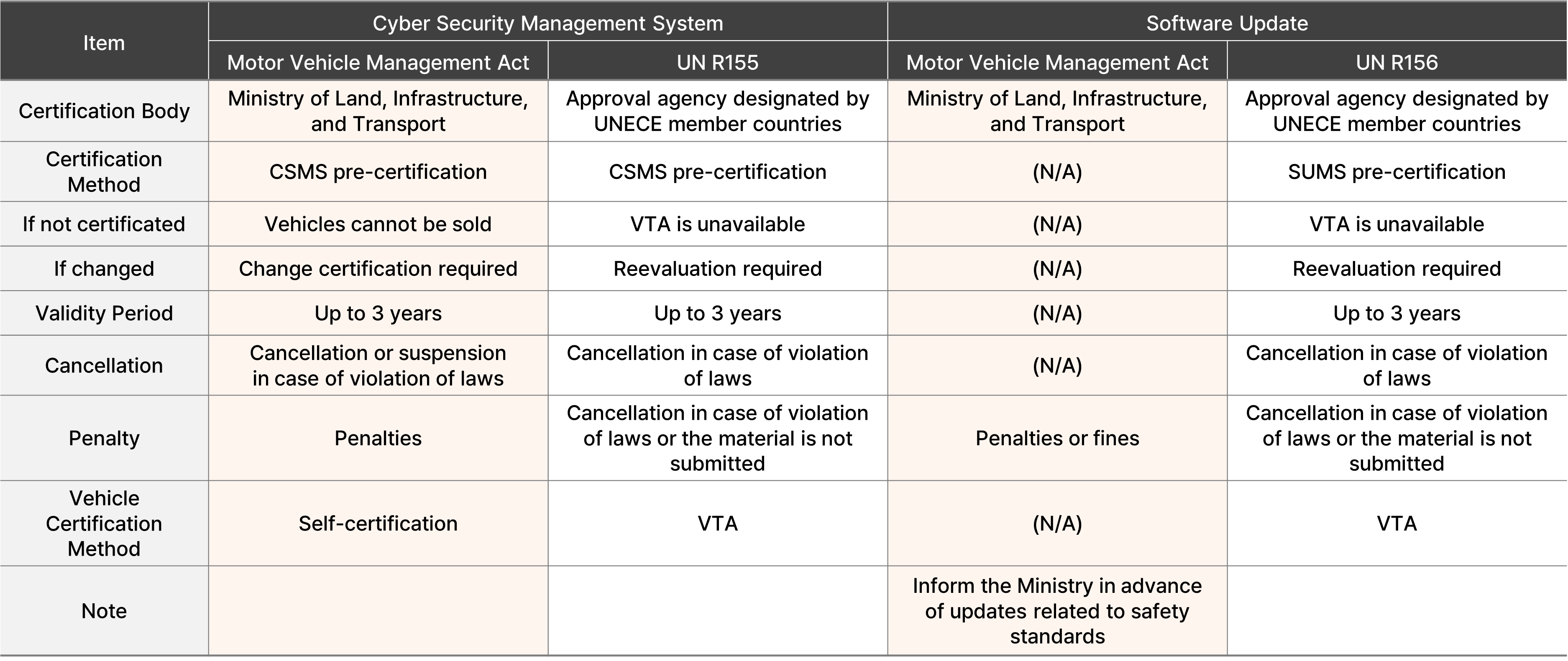
Motor Vehicle Management Act vs. UN Certifications
Let's briefly compare Korean law (Motor Vehicle Management Act) and
European law (UN R155 · R156). Firstly, the certification body is the Korean Ministry
of Land, Infrastructure and Transport under Korean law, whereas under European
law, it is the approval agency designated by UNECE member countries. For CSMS
certification, both Korean and European law require pre-certification, and for
SUMS certification, only European law mandates pre-certification. Without CSMS
certification, vehicles cannot be sold under Korean law, and similarly, European
law prohibits vehicle sales without VTA certification. If the automaker's CSMS
or SUMS changes, it must undergo reevaluation.
The validity period of system certification is up to 3 years, with a
follow-up review required annually after obtaining certification. Violations of
applicable laws may lead to cancellation of system certification. In the event of
law violations, certification may be revoked under European law, while under Korean
law, penalties or fines may be imposed depending on the violation. Lastly,
regarding the vehicle certification methods, European law requires obtaining
VTA certification before selling a vehicle to a UNECE member country, whereas Korean
law allows sales with self-certification, but if violations are found in the
sold vehicle, sales may be ordered to stop.
3. Is it replaceable by UN
certifications (R155 · R156)?

Comparison of Certification Authorities
In conclusion, that is not the case. For CSMS certification under the Motor
Vehicle Management Act, only certificates reviewed and issued through the Korean
Ministry of Land, Infrastructure and Transport are recognized. However, automakers
or sales companies that have obtained CSMS certification under UN Regulation
155 will be able to obtain CSMS certification supervised by the Korean Ministry
of Land, Infrastructure and Transport. This is because the Korean Motor Vehicle
Management Act and its enforcement ordinance are based on UN R155.
Ultimately, the preparations that OEMs or Tiers must make are largely the
same, allowing for adjustments to comply with the Motor Vehicle Management Act.
FESCARO has achieved a grand slam in cybersecurity certification consulting and
possesses a deep understanding of related topics. Therefore, if you need
assistance in complying with the Motor Vehicle Management Act, please contact FESCARO.
4. Cybersecurity and
software update-related contents in the Motor Vehicle Management Act
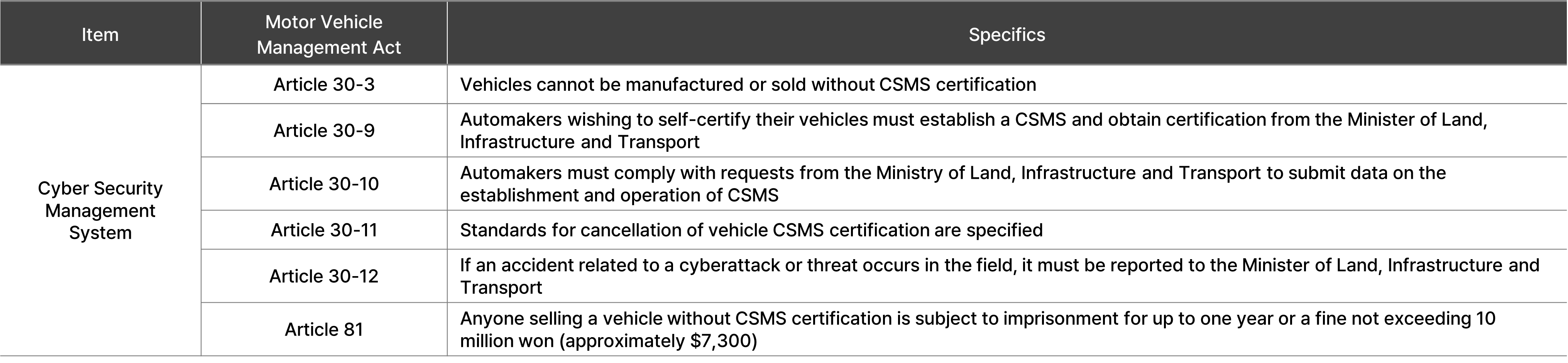
Motor Vehicle Management Act Amendment - Provisions regarding cyber security management system
Each provision of the amendment to the Motor Vehicle Management Act
corresponding to CSMS is summarized as follows.
ㆍ Article 30-3: Vehicles cannot
be manufactured or sold without CSMS certification (Article 30, Paragraphs 9,
10, 11, and 12 specify laws and regulations regarding CSMS.)
ㆍ Article 30-9: Automakers wishing
to self-certify their vehicles must establish a CSMS and obtain certification
from the Minister of Land, Infrastructure and Transport.
ㆍ Article 30-10: Automakers
must comply with requests from the Korean Ministry of Land, Infrastructure and
Transport to submit data on the establishment and operation of CSMS.
ㆍ Article 30-11: Standards
for cancellation of vehicle CSMS certification are specified.
ㆍ Article 30-12: If an
accident related to a cyberattack or threat occurs in the field, it must be
reported to the Minister of Land, Infrastructure and Transport.
ㆍ Article 81: (Penalty) Anyone selling a vehicle without CSMS certification is subject to imprisonment for up to one year or a fine not exceeding 10 million won (approximately $7,300).

Motor Vehicle Management Act Amendment - Provisions regarding Software Updates
The following are provisions related to software updates.
ㆍ Article 34-5: This clause
specifies the following six compliance requirements that must be observed when updating.
Information on updates related to safe vehicle operation must be notified in
advance to the Korean Ministry of Land, Infrastructure and Transport, and the
performance test agent for the updates must be confirmed in advance.
o Update compliance requirements:
① All functions of the vehicle must operate normally even after the update;
② The vehicle must prove compliance with vehicle safety standards even
after the update.
③ The update implementation process must be safe.
④ Update information must be delivered to vehicle users.
⑤ Update contents and history must be safely preserved.
⑥ Any other matters necessary for safe and smooth updating, as prescribed
by the Ordinance of the Korean Ministry of Land, Infrastructure, and Transport.
ㆍ Article 34-6: If the Korean Ministry of Land, Infrastructure and Transport deems it necessary, a performance test agent may investigate the adequacy of the automaker’s updated contents, methods, and management status. (Performance test agent refers to an organization designated as an agent by the Korean Ministry of Land, Infrastructure and Transport, such as KATRI.)
ㆍ Article 35-2: Any
modification, installation, addition or deletion of software that may affect
the safe operation of the vehicle is prohibited.
ㆍ Article 81: (Penalty)
Anyone who violates ①~③ of update compliance requirements will be subject to
imprisonment for up to 1 year or a fine not exceeding 10 million won
(approximately $7,300).
ㆍ Article 84: (Fines) Anyone
who violates the provision for submitting update-related data will be subject
to a fine not exceeding 20 million won (approximately $14,500) and anyone who
violates ④~⑥ of the update compliance requirements will be subject to a fine
not exceeding 10 million won (approximately $7,300).
For specific details regarding requirements and evaluations, enforcement
ordinances and safety standards will be applied under the guidance of the Korean
Ministry of Land, Infrastructure, and Transport, the Korea Transportation
Safety Authority, and KATRI. FESCARO is also working on preparing for
certification and cybersecurity testing, and we will share related news as it
becomes available.
5. What and how to prepare? (OEM/Tier)
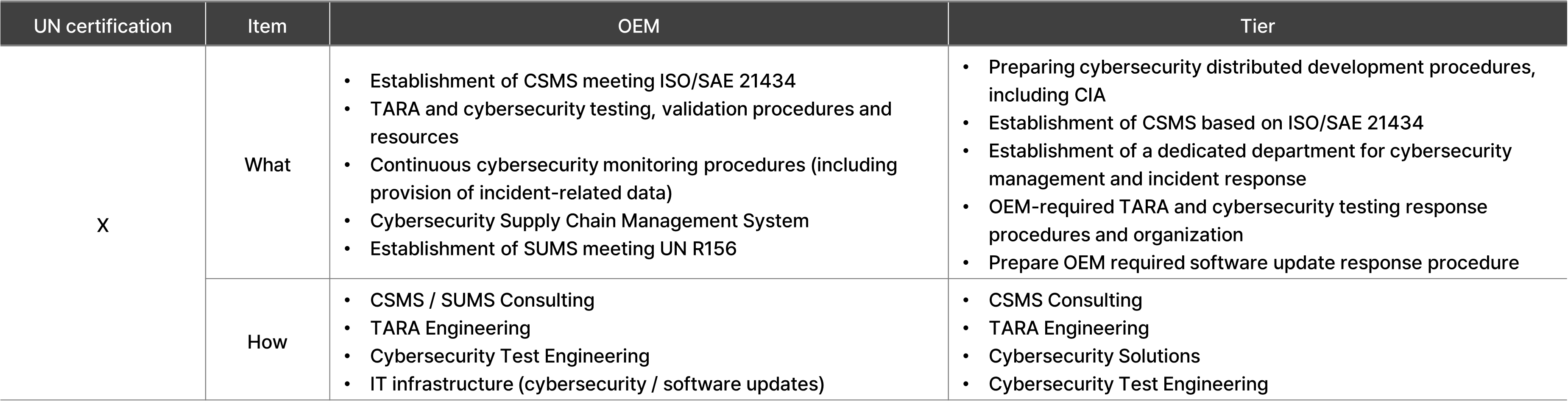
Preparations for OEMs that
have not obtained UN certification
Firstly, we explain from the viewpoint of an automaker (OEM) that hasn't
obtained UN certification. OEMs are obligated to establish a CSMS (Cyber
Security Management System) compliant with ISO/SAE 21434. This system must
remain operational not only during the development phase but also throughout
production and field maintenance diagnosis. Specifically, OEMs need to
implement TARA (Threat Analysis and Risk Assessment) alongside cybersecurity
testing and validation procedures, allocating necessary resources accordingly.
Additionally, OEMs must establish and maintain procedures for continuous
cybersecurity monitoring, incident response, and data reporting. From an OEM
perspective, the most important thing is to have a system for cybersecurity
supply chain management.
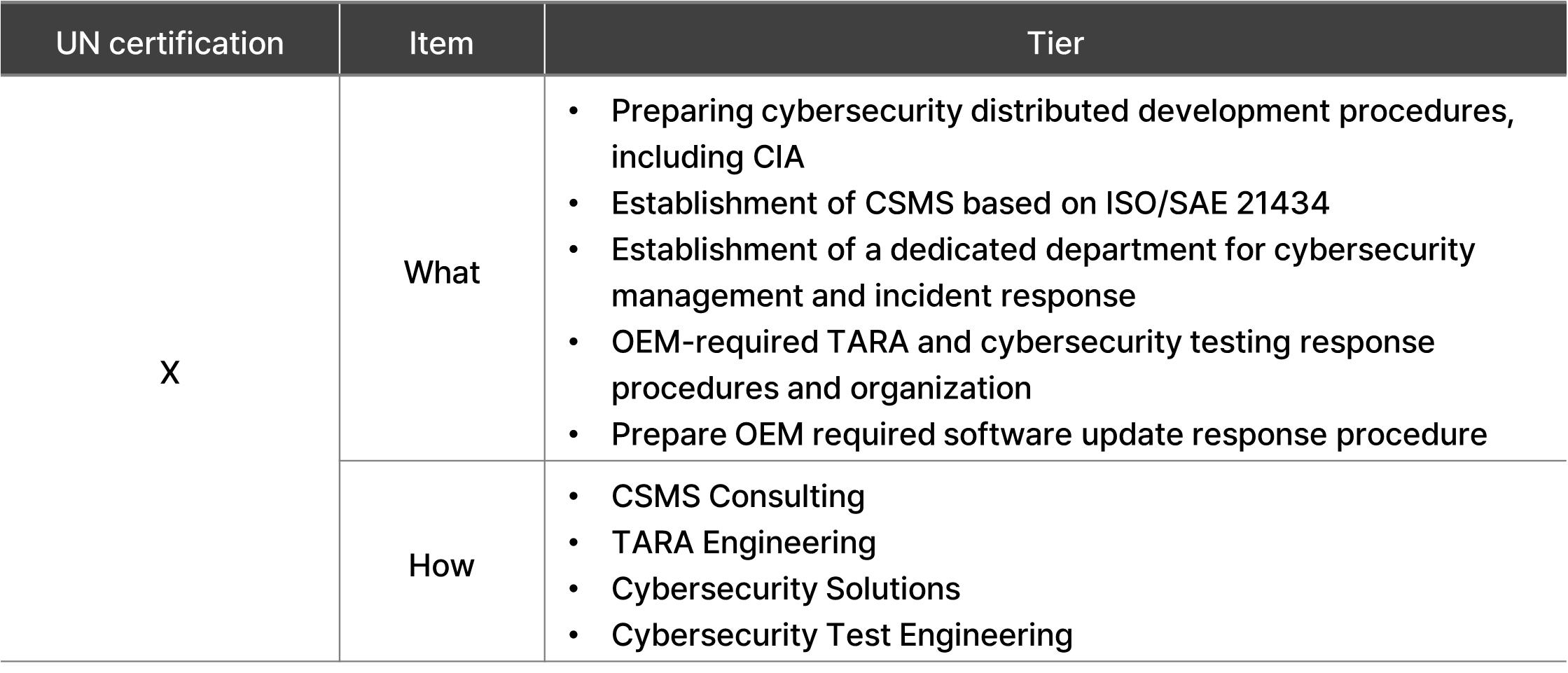
Preparations for Tiers
that have not obtained UN certification
The preparations for controller developers (Tiers) who have not obtained
UN certification are similar to those of OEMs. First, Tiers must establish a
cybersecurity distributed development process that incorporates CIA to address
OEMs' CSMS needs. This is mainly managed by the sales and design departments.
Additionally, Tiers must establish a CSMS based on ISO/SAE 21434 standards and
organize a dedicated department or team for cybersecurity management and
incident response. Finally, Tiers should establish TARA procedures and allocate
resources in advance to meet OEM’s demands. To implement security measures
based on TARA results, it is advisable to apply security technology and prepare
procedures and resources for security testing. From a Tier’s perspective, it is
crucial to ensure the security technology applied to the controller and establish
a security testing system to ensure its quality.

Preparations for OEMs and
Tiers that have obtained UN certification
Lastly, an OEM or Tier that has already obtained UN certification should
proceed with internalization work to review and supplement their existing CSMS
based on the Motor Vehicle Management Act and CSMS certification standards. And
since submissions to the Korean Ministry of Land, Infrastructure and Transport
must be written in Korean, it is necessary to translate the output into Korean.
6. Does the Motor Vehicle
Management Act necessitate modifications to controller software?
Yes, it does. Also, we can say that it's imperative to select a software
configuration and development plan capable of adapting flexibly to evolving
cybersecurity technologies in the future.
The Motor Vehicle Management Act does not describe a very specific
methodology. However, in Article 2 (Definition) 4-4, a cyber security
management system is defined as 'a comprehensive management system including
managerial, technical and physical protection measures to protect vehicles from
cyberattacks and threats.' For clarity, we will show the necessary measures
specified in 5.1.1 of UN R 155 that an automaker (OEM) must deploy in its
vehicles to be certified.
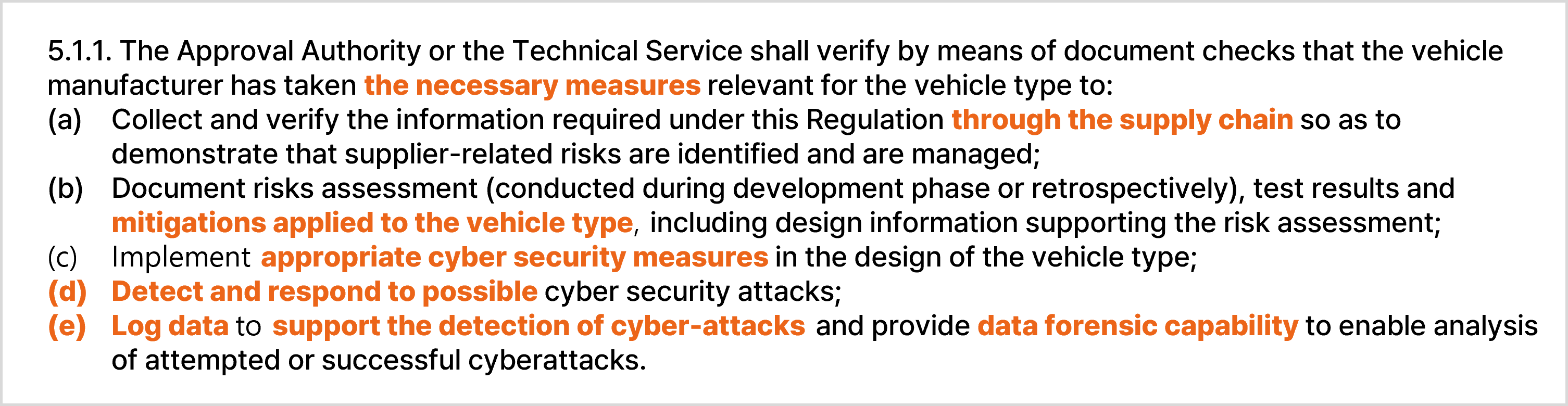
Paragraph 5.1.1 of UN R
155
(a) : Include
not only automakers but also Tiers.
(b) : Reflect
security measures for vehicles.
(c) : Appropriately
implement cybersecurity measures in the vehicle design itself.
(d) : Must
be able to detect and respond to cybersecurity attacks on vehicles.
(e) : Need
log data processing with forensic capabilities to detect and analyze
cybersecurity attacks.
Now, let us explain the above regulations from a SW perspective. The
software must include features to protect the vehicle from external attacks and
manage cybersecurity events that may occur in the vehicle. These security
functions must be applied on a per-controller basis. Functions to protect the
controller itself include Secure Boot, Secure Storage, Secure Debug, Runtime
Tunning Protection, Memory Protection, HSM, OS Hardening, general controller
security requirements, secure coding, and open-source vulnerability management.
There are also requirements to defend the vehicle from external attacks
by protecting communication between the vehicle and the outside and between
controllers within the vehicle, such as Secure Access, Secure Unlock, SecOC,
TLS, IPSec, MACSec, and Firewall. Additionally, CAN-IDS, Ethernet-IDS,
integrated security log, and vSOC (vehicle security operation center)
established by OEMs from an operational perspective are features to detect
security events that may occur in vehicles and create appropriate countermeasures.
Most of these requirements are realized in SW, and the requirements
continue to evolve. Therefore, it is important to choose a SW configuration and
SW development methodology to better respond to requirements more efficiently.
In other words, OEMs and Tiers must be able to effectively manage and develop
SW in order to prepare response plans.
So what is a suitable methodology for SW development? In fact, in terms of the methodology for effectively developing and
managing SW, automotive SW has already begun to increase in importance not only
from a cybersecurity perspective, but also from a long time ago. Not only
standard organizations and specialized companies such as AUTOSAR, Automotive
Grade Linux, Android Automotive, and QNX, but also OEMs themselves are carrying
out these activities. In other industries, there's also a long history of
efforts to manage and develop software effectively. These efforts often involve
standardization to enhance convenience and reusability in software development
processes.
In the automotive SW field, such activities are particularly led by
AUTOSAR, which is also the most widely adopted SW platform. AUTOSAR is an
organization formed by major automakers and controller developers in 2003. It
stands for Automotive Open System Architecture, an automotive SW standard.
Given the ongoing and future necessity of cybersecurity, adopting
standard SW platforms can be an effective strategy for addressing cybersecurity
concerns, particularly in the automotive industry.
7. Is it necessary to
apply AUTOSAR?
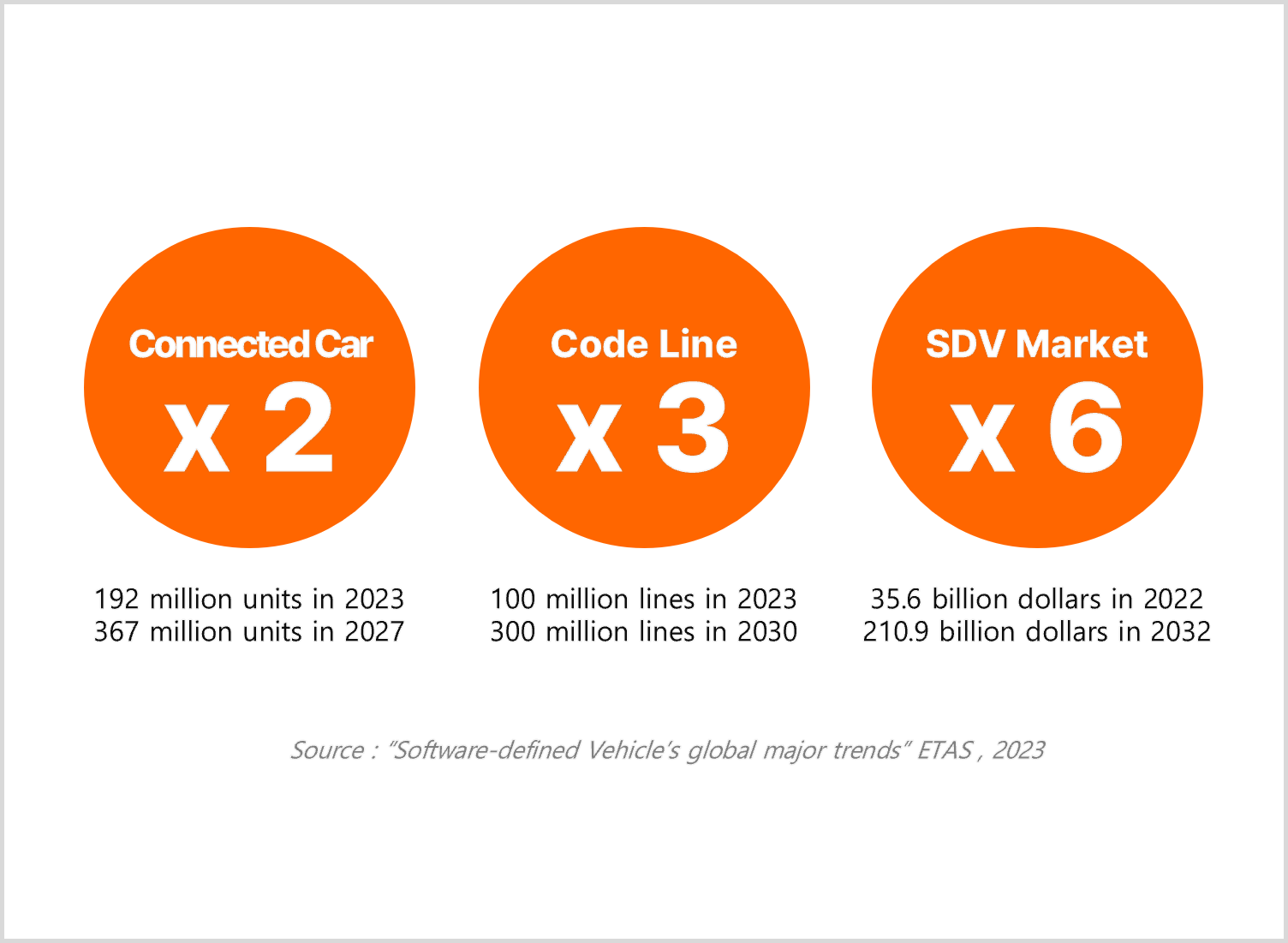
Increasing importance of
SW
Not required, but we would like to say, ‘Shouldn’t we do it now?’ The
increased importance of automotive cybersecurity, leading to legislative
action, is primarily driven by the growing connectivity and electronic
complexity of vehicles. This has led to an explosive increase in the importance
of SW. The vehicles of the future, or rather, modern vehicles, are evolving
toward C.A.S.E (Connectivity, Autonomous, Sharing, Electrification), and as a
methodology to realize this, a major paradigm shift is occurring toward
software-driven vehicles (SDV).
The increase in high-performance electric field controllers, changes in
E&E architecture, increase in connectivity and electrification, and SW
advancement are having a significant impact not only on automakers (OEMs) but
also on controller developers (Tiers). As SW takes up an increasing proportion
of vehicles, more than half of the defects that occur in vehicles are caused by
SW.
While it's nearly impossible to entirely prevent software defects,
refining the controller system, including the software structure, is essential.
Preventive measures should be implemented through rigorous, effective, and
repetitive verification testing. Post-mass production, it's crucial to maintain
software quality activities for rapid response continuously.
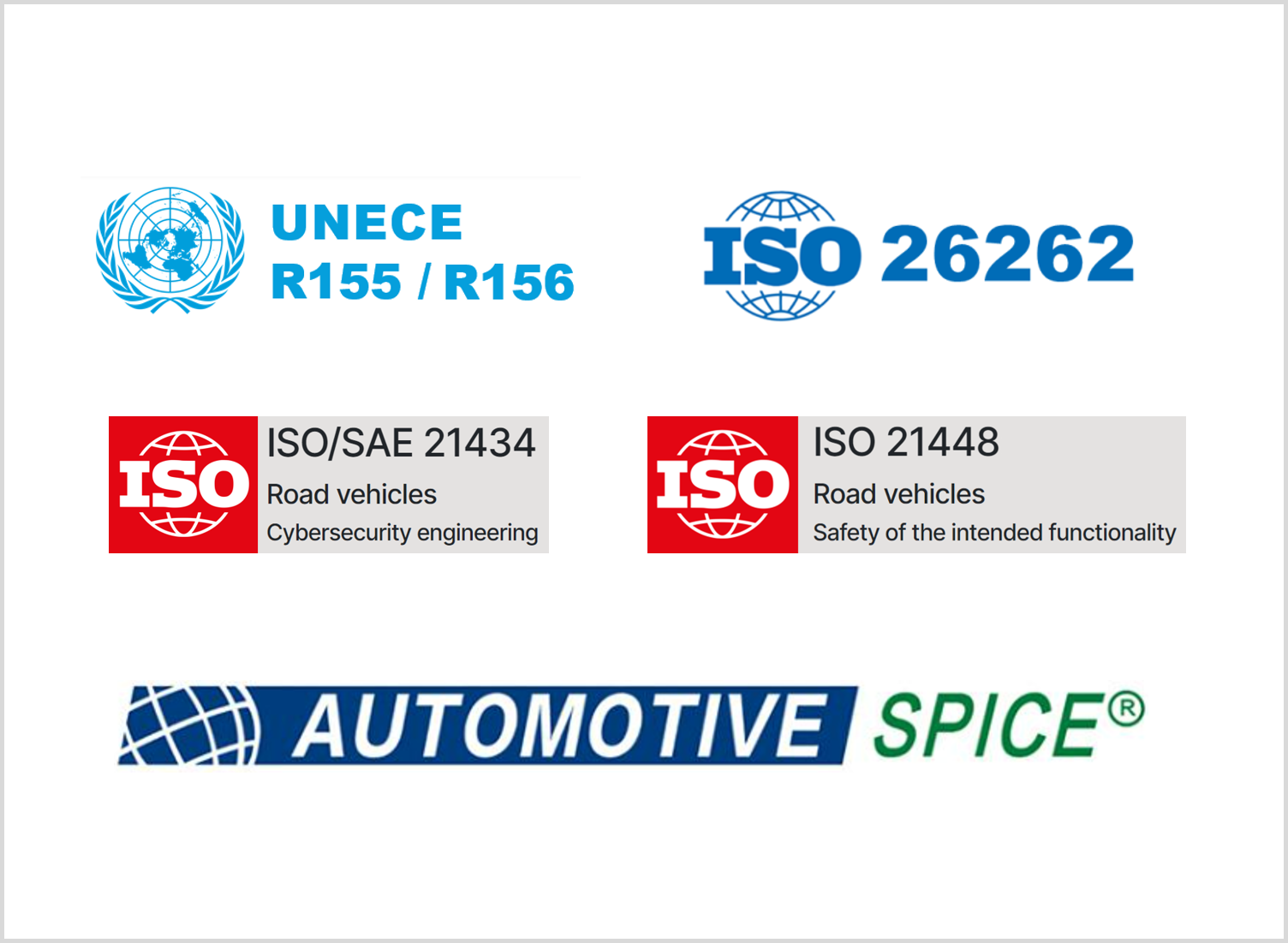
International Regulations
and Standards
Furthermore, the scope of international laws and standards applicable to
vehicle and controller development is expanding, accompanied by specific
requirements. These include UN regulations such as R155 and R156 concerning
cybersecurity and software update management, as well as ISO/SAE 21434, the
cybersecurity engineering standard, functional safety, SOTIF, and A-SPICE. It's
imperative to be well-versed in and consider these standards during the
development process. Preparation for Over-The-Air (OTA), which is becoming essential
for vehicles, is also needed.
As mentioned in response to the previous question, some individuals
anticipated the diverse and complex requirements and changes in software,
leading to the creation of AUTOSAR. These efforts have contributed to enhancing
the efficiency of automotive software development and management.
Standardization in software structure provided by AUTOSAR enables greater
convenience, reusability, and modularization in development, addressing
challenges in adapting to various changes. AUTOSAR serves as a notable
methodology for optimizing development time and cost, meeting new requirements,
and enhancing quality.
So far, we have talked about AUTOSAR as if it is essential, but I would
like to say once again that it is not essential. The decision to adopt AUTOSAR
depends on various factors such as the controller's characteristics, its role
in the vehicle, and the automaker's circumstances. Additionally, implementing
AUTOSAR entails a certain level of cost and effort. Therefore, it's advisable
to carefully assess these factors and environmental considerations before
deciding whether to apply AUTOSAR.
FESCARO has professional capabilities not only in cybersecurity but also
in AUTOSAR. We not only integrate AUTOSAR into our self-developed and
mass-produced controllers but also engage in AUTOSAR-related development
projects with various Tiers. With our extensive know-how in AUTOSAR, we stand
ready to assist you in making the best choice. Please don't hesitate to contact
us if you have any concerns.
8. Can an organization
implement AUTOSAR independently?
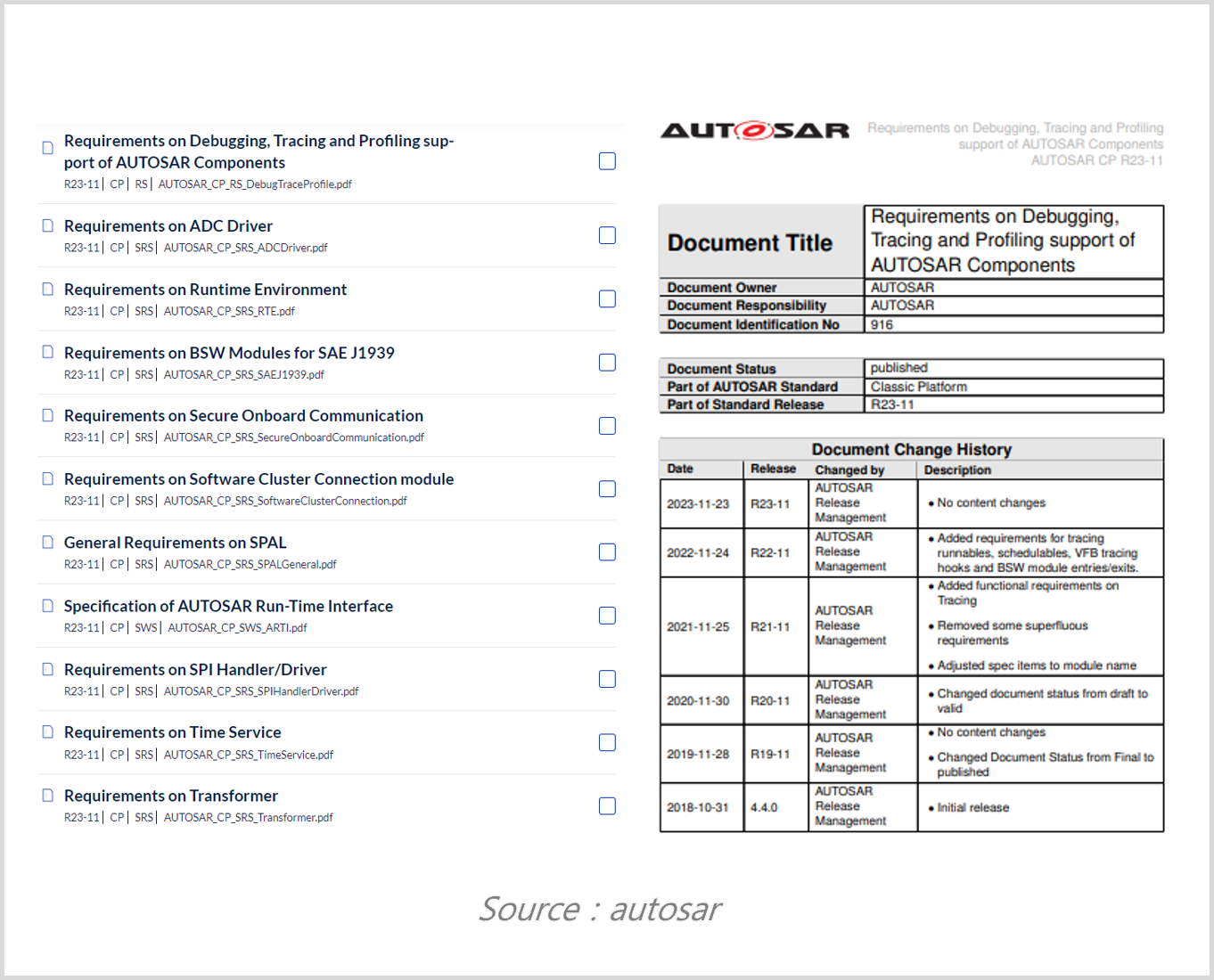
AUTOSAR Requirements
Defined
The short answer is yes. However, automakers or controller developers typically do not do it that way. As mentioned earlier, AUTOSAR stands for Automotive Open System Architecture and serves as an automotive software standard. Additionally, AUTOSAR is also an organization.
This organization defines standards aimed at achieving an automotive open
standard software structure and specifies various requirements to realize this
goal. While it's possible for companies to fully understand and implement these
standards to create their own AUTOSAR-compliant software, they often weigh
various factors such as costs and efficiency. As a result, each company tends
to focus on its strengths and finds a role that best suits its capabilities.
This approach allows for the development of controllers and even entire vehicles
using AUTOSAR.
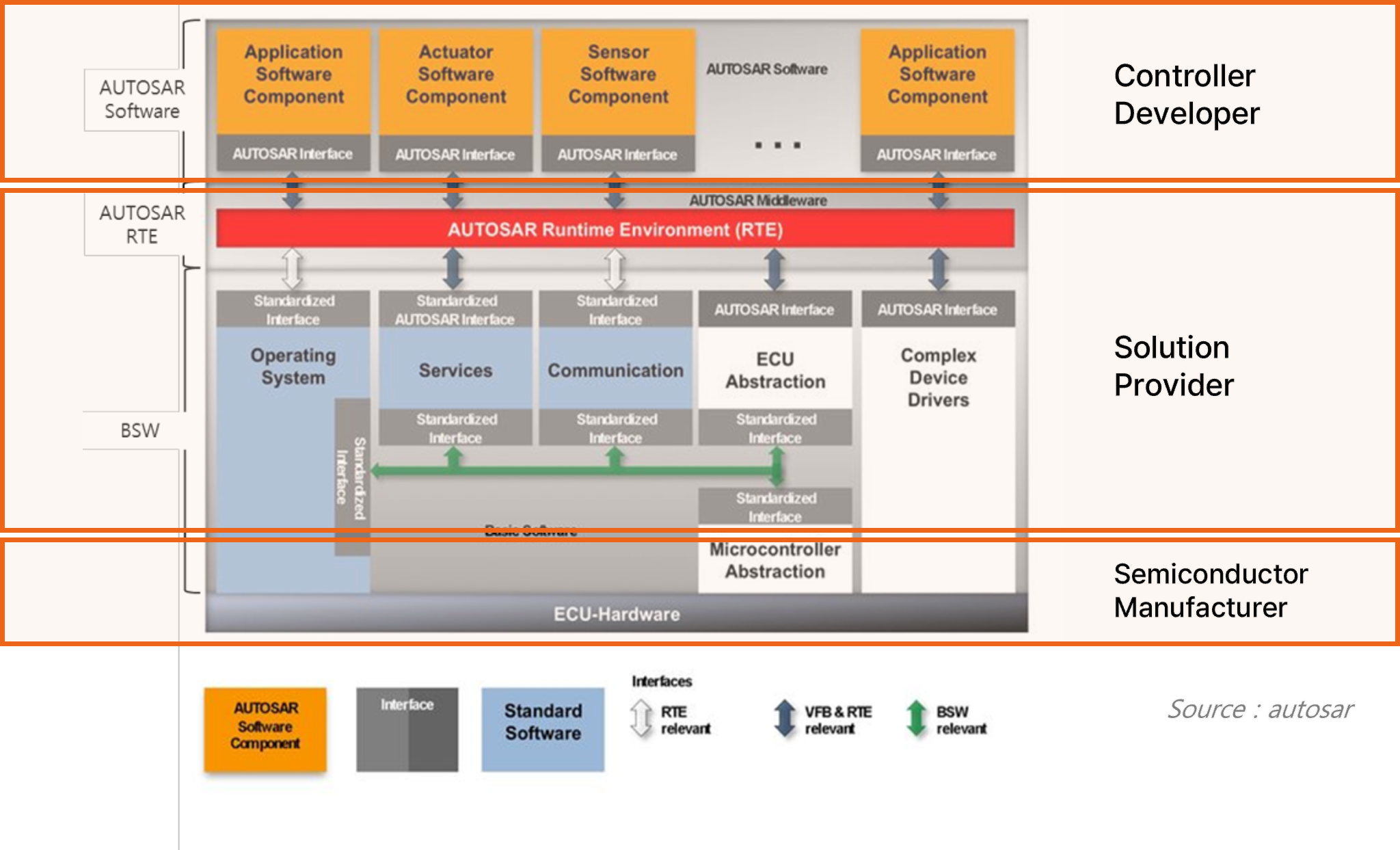
Roles for each company
For instance, semiconductor manufacturers producing MCUs and
microcontrollers for controllers develop MCAL to ensure seamless compatibility
with AUTOSAR on their chips. AUTOSAR solution providers develop BSW and RTE
adhering to AUTOSAR standards, along with various tools for efficient software
management and creation. These AUTOSAR packages enable the creation of software
components tailored for the controller, known as application software, with the
final integration carried out by the controller developer.
When developing a controller, it's prudent to choose an AUTOSAR solution
that aligns with the OEM's requirements, supports the selected MCU, offers
effective engineering services, and optimizes costs. FESCARO maintains close
collaborations with leading AUTOSAR solution providers. If you have any
questions regarding which solution to choose, please don't hesitate to contact
us. We'll assist you in selecting the optimal solution.
9. What should be
considered when applying AUTOSAR?
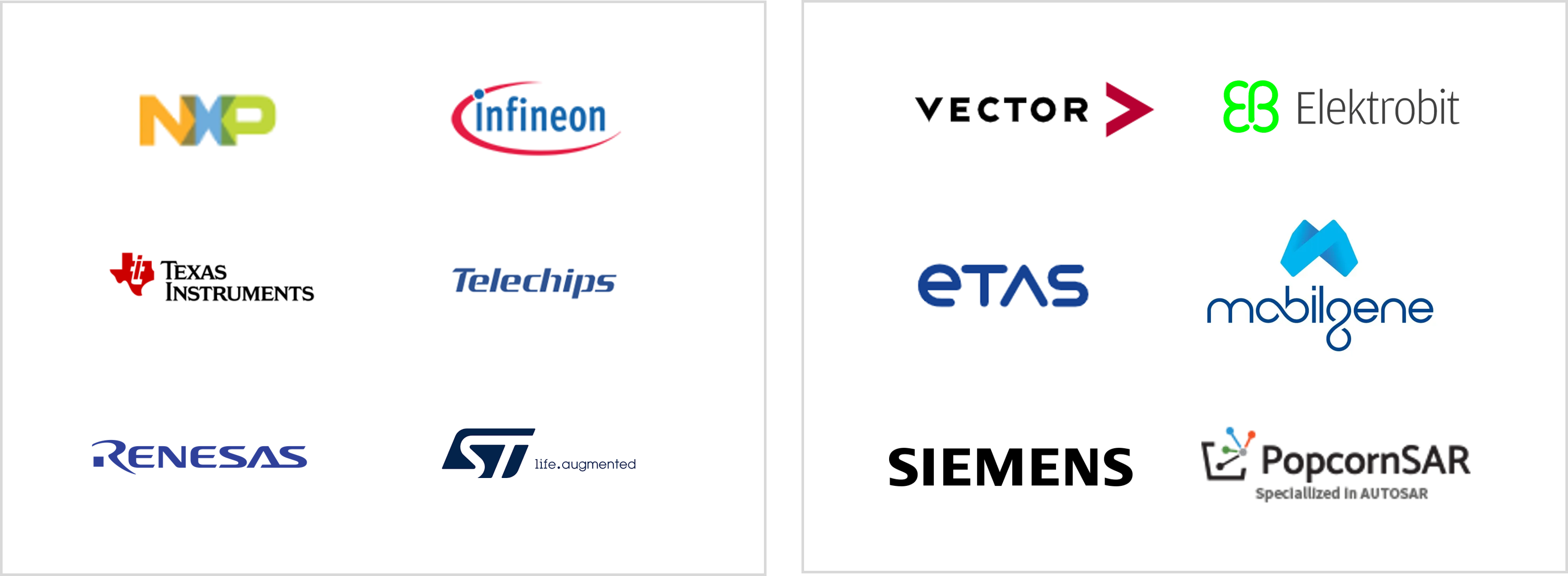
Semiconductor Manufacturers
(L) Platform SW Developers (R)
The primary consideration in applying AUTOSAR is aligning with customer
requirements. Additionally, factors such as the MCU selection and associated
costs are crucial. Internal development capabilities, project schedules, and
proficiency levels should also be taken into account.
As you're aware, constructing a vehicle involves the integration of
numerous controllers. The automaker (OEM) establishes requirements for
controllers tailored to the vehicle's manufacturing needs and distributes them
to Tiers. Upon receiving these requirements, Tiers analyze them and make
decisions regarding their implementation.
In the past, determining the direction of controller development
primarily involved reviewing controller functions. However, in today's context,
additional but essential factors such as cybersecurity, functional safety, and
OTA updates must also be carefully evaluated. This comprehensive review guides
the selection of an appropriate MCU and platform SW. When deciding on the
platform SW, various factors including the complexity of controller functions,
reusability, business scalability, OEM requirements, MCU support, cost, etc.
are taken into consideration.
In today's landscape, many companies opt for AUTOSAR as their platform
software. While OEMs may request it, it's often chosen based on factors like
the product's competitiveness, reusability, and scalability. However,
developing AUTOSAR-compliant software in-house is not feasible, necessitating
the selection of an appropriate solution. When making this decision, it's
crucial to consider whether the chosen solution is compatible with the MCU,
capable of meeting all customer requirements, supported by quality engineering
services, and offered at a reasonable cost.
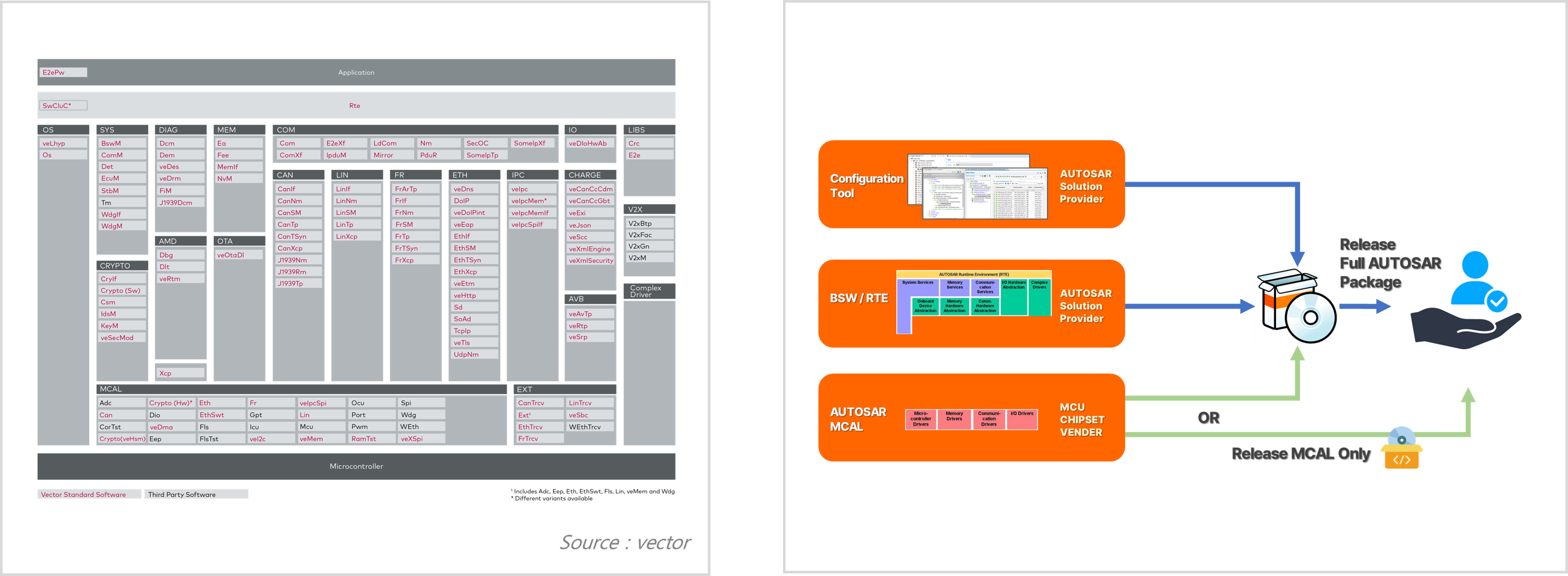
AUTOSAR Purchasing Process
Typically, AUTOSAR encompasses numerous functions. Even after deciding on
the AUTOSAR provider, it's necessary to carefully select the services and components
required for your product within the AUTOSAR BSW. When purchasing AUTOSAR, the
configuration tool, BSW, and RTE are typically provided by the AUTOSAR solution
provider. Additionally, the AUTOSAR MCAL may be obtained directly from the MCU
supplier or included in the AUTOSAR package.
We've provided a brief overview of AUTOSAR and the considerations
involved in controller development. More detailed technical issues will be
covered in our next webinar. We appreciate your continued interest and
participation.
■ Bonus Q&A
During pre-registration for the webinar, we received approximately 100
inquiries. In addition to the questions covered above, we have also addressed
four of the most frequently asked questions. If you're curious about the expert
panel's answers, please check them out in the video (starting from 37:40).
1. What changes from the perspective of Tier 1, which solely provides
software, and how will these changes impact Tiers 2 and 3.
2. The actual impact on cybersecurity and A-SPICE.
3. What preparations should a semiconductor supplier make? Additionally, is
there an international standard that covers the amendments to the Motor Vehicle
Management Act.
4. Do small-scale manufacturers who purchase, manufacture, or sell
special vehicles (e.g., agricultural machinery) or unfinished vehicles also need
to comply with the amendments to the Motor Vehicle Management Act?
■ Webinar Reviews
* Gyun
Kim “I was confused ahead of the implementation of the Korean law, but I was
able to hear a clear explanation of the work between OEMs and Tiers.”
* Haeng Heo “It was beneficial to be able to see the
certification items and subjects at once. I will reflect them in establishing a
plan to acquire cybersecurity certification.”
* Woo Lee “I wish the webinar had been longer, and I’m
curious about how not only Tier 1 companies but also companies undertaking
small-scale modification projects will respond.”
-
PREV [FAQs] ECU Cybersecurity guidance : From production to post-production
-
NEXT No next post.